How do companies find new customers and continue to grow their business? Sales. For a month I learned about sales and created a ready-to-use sales sequence for Quickbooks, an online payroll and accounting service. I divided the work into four weeks. Here’s what I did.
(Scroll down to Week 4 to see my video summary of the project.)
Week 1: Learning the Purpose of Sales
Sales is an outcome, not a goal. It’s a function of doing numerous things right, starting from the moment you target a potential prospect until you finalize the deal.
– Joe Konrath
The first week was learning-centric. Sales is an important skill to have and it is closely intertwined with everything in life. Nearly everything we do has an aspect of sales to it. When we go to a job interview we are selling our ability to create value for a company. When we go on a date, we are trying to sell the person on our value in a relationship. Sales touches every aspect of our lives.
To do good sales, first, you have to know what bad sales look like. During the first week, I wrote two blog posts detailing multiple experiences I have had with sales, ranging from very good, to bad.
The Buyer’s Journey details the process I went through before deciding to purchase a new birdcage. This exercise was great at showing me the steps I took before I purchased, and how that might look different or similar to someone else. I reflected on the stages, realizing there was a problem, looking for solutions, narrowing it down, and finally making the purchase.
Sales Experiences analyses a good sales experience vs a bad sales experience. Everyone has had a bad experience with sales at least once. There is also the stereotypical idea of greasy sales guys coming up to people’s homes and soliciting very disrespectfully. In this post, I talk about my experience with unmet expectations causing me buyer’s remorse, and the time I got more than I expected. After analyzing the importance of sales I started to learn the practical art of selling.
Week 2: Persona’s, Problems, and Solutions.
How you think about your customer influences how you respond to them.
-Marilyn Suttle
For the second week, I created five buyer personas who might be interested in a product that I picked out. The hypothetical product was cleaning services. I wrote up five different characters who needed this solution. You can read about all of them here. The purpose of this project is to understand who might be looking for your service or product. Like Joe Propertyman, a guy who would much rather be fishing than cleaning rental properties. This way helps you tailor your sales and marketing efforts to that group of people.
For the second part of the project, I came up with five problems and then reverse-engineered them to three or more solutions. This was so I could practice the sales mindset of creating solutions, not just asking for sales. Only focusing on what the other person can give you is a sure way to fail with sales. You almost always need to be convinced that you are offering a solution to their problem, not just setting yourself up for financial returns.
Taking all of this into consideration, it was time to choose the company I would be creating the sales sequence for. I chose QuickBooks by Intuit, an online accounting service. It helps track income, maximize tax deductions, and do payroll. The main person who needs it? HR managers or small business payroll people. So with my ideal customer in mind, and the solution to their problem, I made my way over to week three.
Week 3: The Sale’s Sequence
Hard training, easy fight.
-Field Marshall Alexander Suvorov
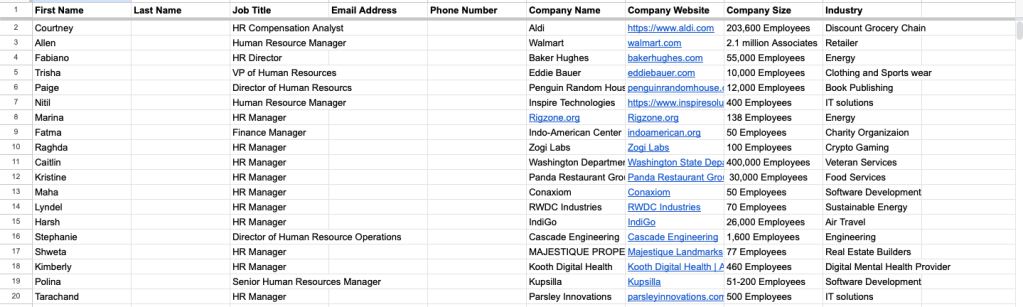
Now that I understood the process it was time to create a sale’s sequence. To start with, I compiled a leads list of HR managers from different companies. This step took a while because I had to complete everything manually, but I could pull it off. My system included looking up HR managers on LinkedIn and finding the place where they worked.
Since I hadn’t created my LinkedIn profile soon enough, I couldn’t access their profiles making it very hard to create this list and impossible to use the tools I was recommended. However, I could still see different places of work, which helped in my search. I took the job and googled HR managers for it and found the rest of the data from there. Suffice it to say, this took a while.
While I didn’t actually contact any of these leads, this exercise showed me the work that goes into identifying and collecting information for sales. Here you can see a version of the leads list I made. (Last names and contact info removed for privacy.)
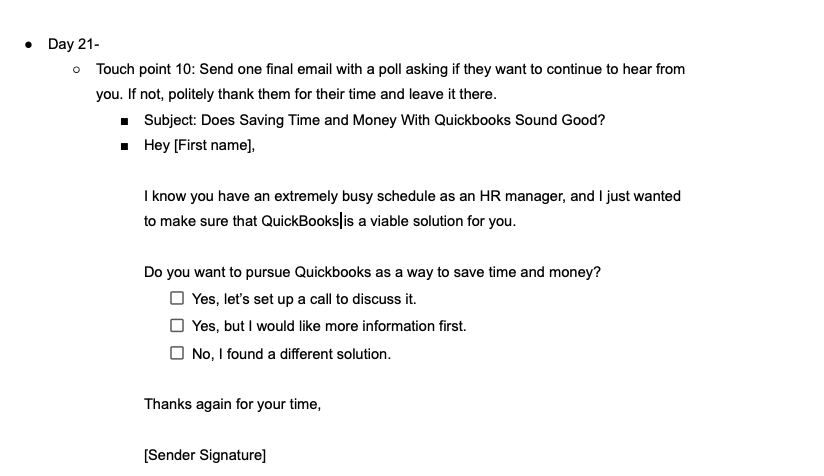
The next part of the project I worked on involved learning about outbound sales, such as cold calls or other sales forms that include reaching out to potential customers. I then crafted a sales sequence. This sequence would take place over 21 days with a few different forms of contact such as emails, LinkedIn requests, and cold calls. For the emails and LinkedIn requests, I wrote drafts that could be used. If you would like to see those I detailed it in a blog post here.
The final step in this process was learning how to navigate a few different platforms that I could have used to launch this sequence to my leads list. This step was by far the easiest part of the process because I didn’t have to apply anything, just learn. I am confident that in the future if need be I could launch a full sales sequence.
Week 4: Recording the Process
Then, with all that completed, I spent the last week compiling my work into this comprehensive post for all of you. I also made a quick video summary to recap what I did.
What I Wish I’d Done Differently
This project was not without its fair share of difficulties and frustrations. I think the main thing I would do differently next time is have an active and useable LinkedIn account to gather leads quickly. But overall, that was the most frustrating part of this whole process, and I eventually figured it out.
Final Thoughts
This project taught me so much about the purpose of sales and the effort that goes into it. Everything, down to the last detail, can be scrutinized and optimized. As a one-man army doing a much smaller, and not official, sales sequence, I can hardly imagine being at a much larger company doing the full-scale thing!
All this to say, sales is an important part of every business, and if you learn it well, it will take you far.
 Genuine Gwyn